The Editorial that Defends a Ghostwritten Paper by Citing Additional Ghostwritten Papers




A few days ago, sixty-four individuals co-signed an editorial in Archives of Toxicology calling for the reversal of the November 2025 retraction of Williams, Kroes & Munro 2000 (hereafter WKM2000), published in the journal Regulatory Toxicology and Pharmacology. The editorial, authored by Christopher Borgert and 63 others, appeared on the author's LinkedIn page prior to official journal publication (hereafter, Borgert2026).
Part of that editorial is devoted to characterizing our work (Kaurov & Oreskes 2025), which led directly to the retraction of WKM2000. Another part of their argument is based on a paper by Helmut Greim et al., published in 2015, that has been analyzed and shown (by one of us) to have been ghost-written and misleading (MacLean 2026, preprint). We are publishing this response to state our position on the record, and because the editorial, taken together with the Undark interview that the editorial’s lead author gave on April 20, is more revealing as a document (indeed a record) than its 64 authors may have intended.
For readers who want the back story of this particular retraction and our involvement, we direct you to our previous Reckoning Science essay on the same subject. The short version: in July 2025 two of us published a paper in Environmental Science & Policy tracing how the WKM2000 review article that was conceptualized and largely ghost-written by Monsanto employees, came to function for 25 years as a citation anchor for "independent" assessments of glyphosate safety. We are not toxicologists writing about glyphosate; we are historians of science writing about the corporate authorship of science, with this paper as a case study. We requested retraction, based on the fact that ghost-writing is recognized as a form of scientific misconduct. The journal processed the request on its own timeline, and retracted the paper in late November 2025. The editor, Martin van den Berg, offered a detailed account of why retraction was necessary, including clear evidence of bias.
The retraction happened to land within days of the U.S. Solicitor General's brief supporting Bayer's appeal in Durnell v. Monsanto, now before the Supreme Court. That timing was plainly not under our control, and certainly not motivated by the timing of the Supreme Court’s docket.
We will respond to the editorial in two registers: first, on the arguments it makes; second, on the disclosures it makes (and omits).
The arguments
Committee on Publication Ethics
Borgert2026 implies that the retraction under the Committee on Publication Ethics (COPE) guidelines requires demonstration of “fraud or scientific flaws” and that, absent such demonstration, the retraction is "editorial overreach." This is not what COPE actually says.
COPE's retraction guidelines explicitly include "clear evidence that the findings are unreliable… as a result of major error… fabrication (e.g., of data) or falsification (e.g., image manipulation)" and — separately — papers that "report unethical research" or contain "plagiarism" or "redundant publication" or where "the paper has been published with inappropriate authorship." These are listed as independent grounds. Ghostwriting is a species of inappropriate authorship. COPE does not require that an editor demonstrate scientific error before acting on undisclosed authorship; the two grounds operate in parallel.
Notably, Borgert2026 has the following statement that is not supported by the references it cites itself.
The editor’s rationale overlooks essential facts that undermine its validity, including the absence of any new evidence beyond Monsanto emails from 2015, which were unsealed in 2017 and already addressed in prior reviews without finding misconduct (Cornwall 2017; Malkan 2025; Mozart 2025).
None of the three sources cited supports the claim. Cornwall (2017) is a Science news report in which Williams's (W from WKM2000) institution, contacted for comment, returned a statement that its internal review had found no misconduct. It did not release the review's terms of reference, methodology, evidence base, or standard of misconduct applied. A reported denial by an interested party, undocumented, is not a prior review; it is an unverified self-clearance. Malkan (2025) is a U.S. Right to Know piece whose entire framing is that the ghostwriting constituted scientific misconduct that the system failed to act on for eight years — the opposite of the proposition it is cited to support. And the Retraction Watch coverage (mis-cited here as "Mozart 2025," apparently derived from the photo credit at the top of the article) is straightforward news reporting of the journal's retraction notice.
Selective enforcement
Borgert2026 also alleges that COPE's application here is "arbitrarily selective," converting the guidelines into "a tool for selective enforcement rather than for equitable oversight." We do not have any insider statistics that the publisher or the editors of the journals might have, but in the course of our research we raised authorship and disclosure concerns about Kier & Kirkland (2013) and Greim et al. (2015) — the two descendant reviews most directly modeled on WKM2000 and the ones directly invoked in the 2015 Monsanto internal email. These papers were published in a different journal — Critical Reviews in Toxicology. We have not received any reply from the Editor-in-Chief and only got a response from the publisher without any specifics regarding how the case will be considered. The Editor-in-Chief of this journal and Greim, are co-signatories of Borgert2026. In contrast, our request to Regulatory Toxicology and Pharmacology was replied to promptly by the Editor-in-Chief acknowledging the receipt of our request.
The deeper objection, which we think the editorial is reaching for without quite articulating, is that the COPE-style retraction apparatus is itself problematic: in the editorial's own phrase, "merely established to shield publishers from accountability." We do not have any specific affection towards the current publishing system; however, COPE is not a regulator and has no enforcing power. Membership in COPE is elective, and adoption of its guidelines is a publisher-level decision. Elsevier, the publisher of Regulatory Toxicology and Pharmacology, is a COPE member and applies COPE guidelines across its journals as a matter of publisher policy. Taylor & Francis, the publisher of Critical Reviews in Toxicology, is also a COPE member. Every editor who has agreed to edit at these and other journals has agreed, by that act, to operate within those guidelines. A substantial fraction of the 2026 editorial's signatories are current or former editors within that same rule system. It would be odd to volunteer to edit inside a COPE-bound publishing ecosystem for decades and, on the day a specific retraction is issued under those same guidelines, treat the guidelines as an external imposition on scientific freedom.
The authors have a point we accept without argument: that we are not toxicologists. COPE retraction requests, however, can be made by anyone, including a member of the public. The question of who asked for the retraction has no bearing on whether the request was warranted. That is to be judged by the journal itself. Indeed, the retraction notice does not mention us or our research. But we would invite the field to sit with the implication of the editorial's framing here. The Monsanto Papers entered the public record in 2017. The internal Monsanto email referring to having "handled" WKM2000 has been on the public record for eight years. In those eight years, no toxicologist elected to file a retraction request. It took two outsiders. If the authors regard our background as a credibility concern, we would like to reverse this argument and ask what this situation tells us about the credibility of the field of applied toxicology as a whole?
“Scientific flaws”: Why Greim et al. (2015) Cannot Validate WKM2000
Borgert2026’s central substantive argument is that WKM2000 does not need to be retracted, because its conclusions were subsequently confirmed by independent and reliable scientific research. The editorial makes the claim in three parts. First, it responds to one of the concerns in the retraction notice that lists studies that were not included in the WKM2000 review. Borgert2026 claims that these studies "have since been published and analyzed in a 2015 review by Helmut Greim and colleagues in Critical Reviews in Toxicology”. Second, Borgert2026 claims that subsequent review by Greim et al. (2015, hereafter Greim2015), "concluded there was “no evidence of a carcinogenic effect related to glyphosate treatment” and no plausible mechanism for such an effect." Third, Greim2015 "directly supports the original findings of Williams et al., demonstrating that including the omitted studies would not have altered the conclusions of the 2000 paper."
But the editorial's defense on purportedly scientific grounds is no such thing. It is a brazen attempt to bootstrap the unreliable findings of a ghostwritten paper (WKM2000) by relying on a second ghostwritten paper (Greim2015) that turns out to be even less reliable than its predecessor.
IARC Finds Greim2015 Incapable of Independent Evaluation
In 2015, the International Agency for Research on Cancer (IARC), broadly considered the world’s most authoritative independent voice on the causes of cancer, classified glyphosate as a “probable human carcinogen.” In 2017, it issued a further report (IARC Monograph Volume 112) elaborating on its 2015 methodology and findings.
As part of its 2015 review, the IARC Working Group evaluated the rodent carcinogenicity evidence for glyphosate. For several of the studies that had never been published in the primary literature, the only analytical presentation available to the Working Group was a summary provided in Greim2015 and its supplementary materials. The Working Group's determination, reported in its 2017 monograph, was that Greim2015's data tables were inadequate. In the mouse section, IARC stated that Greim2015's "review article and its supplement" was "insufficient" to evaluate the new studies because information was "lacking on statistical methods, choice of doses, body-weight gain, survival data, details of histopathological examination, and/or stability of dosed feed mixture" (IARC 2017, p. 354). The Working Group applied this finding specifically to seven of the fourteen rodent studies that Greim2015 purported to present, including studies 4, 5, 6, 8, 12, 13, and 14. The latter was very important—it was a 2001 study by Kumar, often considered the pivotal mouse carcinogenicity study in the entire glyphosate dispute.
The list of Greim2015’s omissions—statistical methods, dose choice, body-weight gain, survival data, histopathological detail, feed stability—is not a list of refinements. It is the list of basic elements required for a competent expert to evaluate a rodent carcinogenicity study.
If IARC's expert working group could not use Greim2015's data presentation to evaluate half of the studies it claimed to examine, that paper cannot validate anyone else's conclusions about those studies. Borgert2026's central claim—that Greim2015 shows that the omissions from WKM2000 "would not have altered the conclusions"—presupposes that Greim2015 produced an analytical output in respect of those studies that a subsequent reader could meaningfully and robustly test. In other words, it presupposes that the Greim2015 study was reliable. But IARC concluded that it was not. Borgert2026 is invoking a questionable study to defend a questionable study.
This failure of Greim2015 is an independent and sufficient ground on which to reject the editorial's pretense to defend WKM2000 on its scientific merits. This ground does not require the reader to accept anything about Monsanto's conduct, about ghostwriting, or about any specific allegation of scientific fraud.
Monsanto ghostwrote Greim et al. (2015) as a follow-up to WKM2000
The same internal Monsanto documents that described WKM2000 as "'the' reference" on glyphosate safety also described the strategy for the paper that would become Greim2015. A 2015 email from Monsanto executive William Heydens, produced in litigation and now in the public record, states: "we would be keeping the cost down by us doing the writing, and they would just edit & sign their names, so to speak. Recall, this is how we handled Williams Kroes and Munro 2000" (WKM2000). That email names Prof. Helmut Greim as one of the academics whose signature the company was planning to attach to its own work. Separately, Monsanto employee David Saltmiras noted that he "ghost wrote cancer review paper Greim et al. (2015)" in his own 2015 internal corporate performance evaluation. The documentary record of the ghostwritten authorship of Greim2015 is not ambiguous.
Kumar (2001) was a private study commissioned by the German glyphosate manufacturer Feinchemie Schwebda, which found dose-dependent malignant lymphoma in male Swiss Albino mice. However, Greim dismissed these results by attributing the tumors to a viral infection in the study colony. No such infection, however, is reported in Kumar (2001). In fact, Greim2015 offers no evidence whatsoever for the contamination hypothesis. This alone should cast doubt on Greim2015. But there is more.
Independent reanalysis by Christopher Portier, published in Environmental Health in 2020, found "no indication in the study report of a viral infection nor any indication that these animals were unhealthy." The German Federal Institute for Risk Assessment (BfR), the European Chemicals Agency (ECHA), and the German toxicologist Peter Clausing with the Pesticide Action Network (PAN) independently reached the same conclusion. How could Greim2015 have made such a patently false claim? It seems fair to conclude that Monsanto’s influence likely had something to do with it. Yet, this is the paper on which Borgert2026 relies to defend WKM2000. But two ghostwritten papers do not make a right.
Greim2015’s patent misrepresentation of the Kumar study did considerable damage.
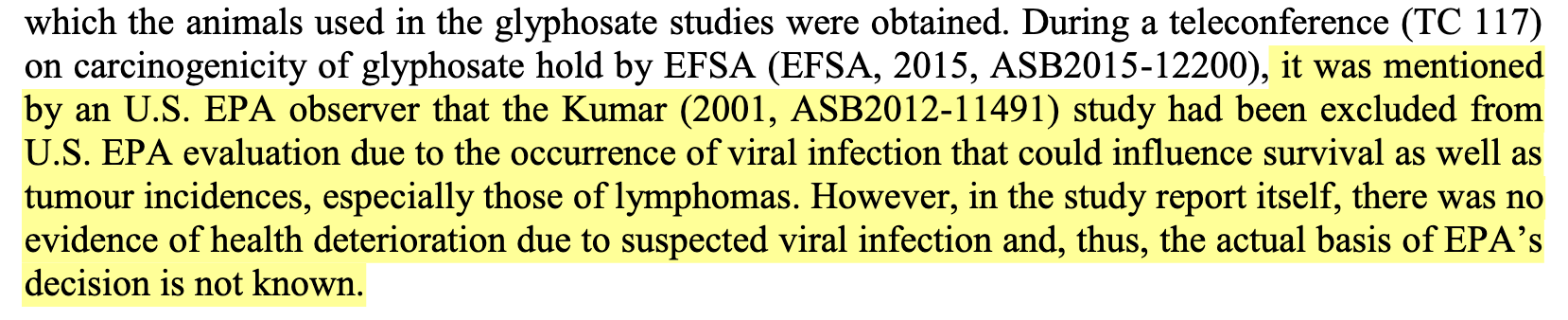
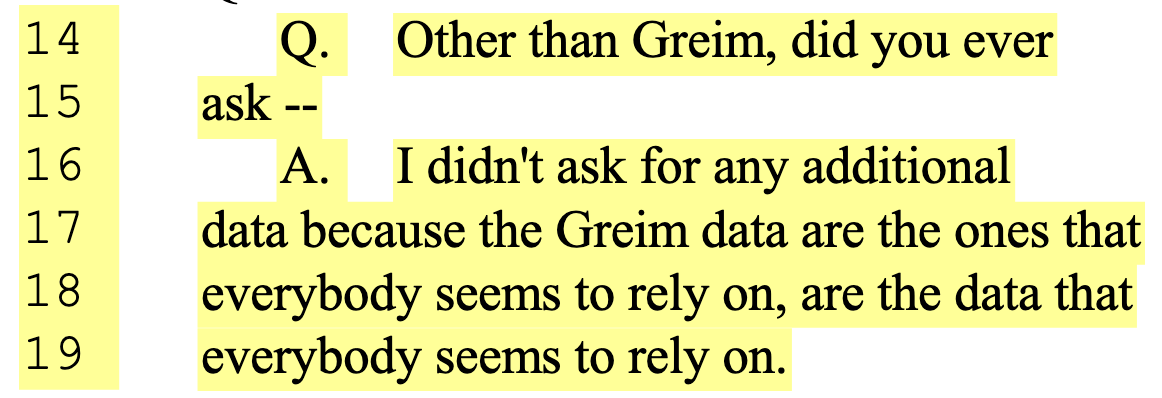
The EPA's Jess Rowland relayed it to a 2015 EFSA/BfR teleconference as an established fact. EFSA adopted it in its 2015 glyphosate assessment. The EPA's 2016 draft and 2017 final cancer assessments excluded the Kumar study on the sole basis of Greim2015’s dismissal, each report citing Greim2015 eighteen times. The Canadian Pest Management Regulatory Agency (PMRA), the Australian Pesticides and Veterinary Medicines Authority (APVMA), and the New Zealand Environmental Protection Authority (NZEPA) did the same. The Federal Court of Australia relied on Greim2015 in McNickle v. Huntsman (2024) to dismiss the only Roundup class action on which a court has ever made findings of fact. In the United States, Monsanto's expert witness testified and Judge Vincent Chhabria accepted in the U.S. multidistrict litigation that "the Greim data are the ones that everybody seems to rely on."
It is because of this ongoing undue reliance on Greim2015 by regulators and courts that one of us (MacLean, preprint) has argued for and formally requested its retraction. As of this writing, Taylor & Francis, the publisher of Critical Reviews in Toxicology, the journal that published Greim2015, is considering the request.
The editorial’s failure to disclose any of this
Borgert2026’s defense of WKM2000 also relies on a second paper by Williams of Williams, Kroes & Munro, Williams et al. (2016), published in the same journal—Critical Reviews in Toxicology. Perhaps not surprisingly, Helmut Greim is one of the authors of Williams et al. (2016), and, also perhaps unsurprisingly, the authorship and reliability of Williams et al. (2016) have been called into question. In November 2018, Critical Reviews in Toxicology issued an “Expression of Concern” about that paper, in response to a retraction request by the non-profit Center for Biological Diversity. The expression of concern also applied to other papers appearing in a special issue on glyphosate, noting that the authors’ disclosures "did not fully represent the involvement of Monsanto or its employees or contractors in the authorship of the articles." In fact, the whole special issue was conceptualized and organized by Monsanto employees, as a rejoinder to the IARC.
And there is more. Critical Reviews in Toxicology, where both Greim2015 and Williams et al. (2016) were published, is currently edited by one of Borgert2026’s signatories, Peter J. Boogaard. Another signatory is Roger O. McClellan, who is emeritus Editor-in-Chief (1987-2025). Their roles as Editor-in-Chief of the journal appear in the affiliation list as a neutral credential. But a full disclosure would have noted that:
- the journal published both of the papers that purportedly validate WKM2000, but have now been called into question;
- the journal has issued a formal Expression of Concern over one of those papers;
- the journal's publisher, Taylor & Francis, is currently investigating a retraction request regarding the other.
Boogaard and McClellan have an obvious conflict of interest, in that they are defending questionable papers published in their journal.
In short, Borgert2026 seeks to rehabilitate an unreliable (and arguably fraudulent) paper by citing two other unreliable papers, betting that we will not notice, or know, the connection.
The disclosures
Borgert2026 acknowledges that "many" of the signatories to the editorial have been "engaged and in some instances have been compensated for their participation in discussions involving scientific integrity, communication, and publication practices," and that "some authors have published in journals edited by other co-authors, a practice that is common in scientific publishing."
Sure. But this disclosure rhetorically dissolves the distinction between the everyday motivations any human being brings to their work and direct financial relationships with parties whose products are the subject of the science. The former is universal and uninformative. The latter is what disclosure norms actually exist to surface, for the obvious reason that financial incentives can bias scientific work.
Borgert2026 also mentions our funding. We have been entirely open about the fact that our research is partly funded by the Rockefeller Family Fund (for Kaurov and Oreskes). Borgert2026 uses this to allege that we have an anti-corporate bias. But the Rockefeller Family Fund is a non-profit foundation, with no financial interest in glyphosate, nor in its regulation. We have nothing against corporations, per se (One of us began her career in the mining industry, and is to this day proud of the work she and her colleagues did. And we have often publicly stated there are many corporations that make good products that improve our lives.) Our interest is in scientific integrity, which ghost-writing and undisclosed financial relations threaten. We also have a human and humane interest in public health, which inadequately regulated chemicals threaten.
All science costs money, but what the Borgert2026 signatories elide are the specific industry relationships of its signatories with respect to the paper they are defending and its descendants. Williams’s and Greim’s relationships to Monsanto have already been spelled out. Here are a few more.
Sir Colin Berry and Keith R. Solomon are co-authors on the special issue that included Williams et al. (2016) that earned an expression of concern.
Gio B. Gori became the Editor-in-Chief of Regulatory Toxicology and Pharmacology after WKM2000 was published. During his tenure, 45 scientists wrote an open letter with concerns about the journal, and about Gori receiving funding from the Tobacco Institute for writing a favorable paper in the journal he edited.
Another two co-signatories of the editorial are mentioned in that open letter: Roger O. McClellan and Dennis Paustenbach. Dennis Paustenbach is a founder of ChemRisk. An internal letter released in asbestos litigation has him writing to Ford's general counsel that his firm's papers had "changed the scientific playing field in the courtroom," and complaining that Ford's fee structure was "out of date.” A ChemRisk-authored paper on chromium-6, originally published with no disclosure of PG&E funding or ChemRisk's role, was retracted from the Journal of Occupational and Environmental Medicine in 2006.
Another five signatories are co-authors of a paper in the journal DARU Journal of Pharmaceutical Sciences, criticizing post-publication peer review platforms. One of them is also an Editor-of-Chief of that journal. This paper had multiple AI-hallucinated references, as reported by Retraction Watch.
Another group of 10+ individuals are consultants from various companies. Five of them are from Exponent, a larger consulting company accused of producing favorable reports for industry.
Since the editorial mentions our funding and our expertise, we felt that to have the complete picture it is worth mentioning some of their affiliations. Sixty-four is a lot of names; we apologize for not going through the whole list. However, what is listed above probably gives a picture of the views on scientific research and publishing the co-signatories hold.
Borgert gave an interview to Undark, published on April 20. Asked whether universities and public institutions have a different orientation toward the public good than companies "fundamentally required to fulfill a bottom line," Borgert replies: "I think you're living in a pretend world." The editorial's COI disclosure makes the same move at the institutional level by listing a range of categories of motivation as if they were equivalent to direct financial conflict.
Asked, in the same interview, whether he thinks glyphosate at typical exposure levels is harmful to human health, Borgert says: "Can't answer the question." He then explains that he hasn't kept up with the literature.
PS: At the end of the Undark interview the lead author of the editorial notes that he hopes Bayer or another entity will reimburse him the $6,400 open access fee for the editorial. We feel the pain. Therefore, we would also like you, the reader, to donate to our efforts as well in incremental amounts of $6,400. We even have a convenient online portal to do so: https://reckoningscience.org/#/portal/support . Alternatively, we invite you to become a subscriber to this newsletter / research blog.