Accidental climate science
Records kept for harvests, gods, festivals, and trade now tell us about the changing climate.

Records kept for harvests, gods, festivals, and trade now tell us about the changing climate.
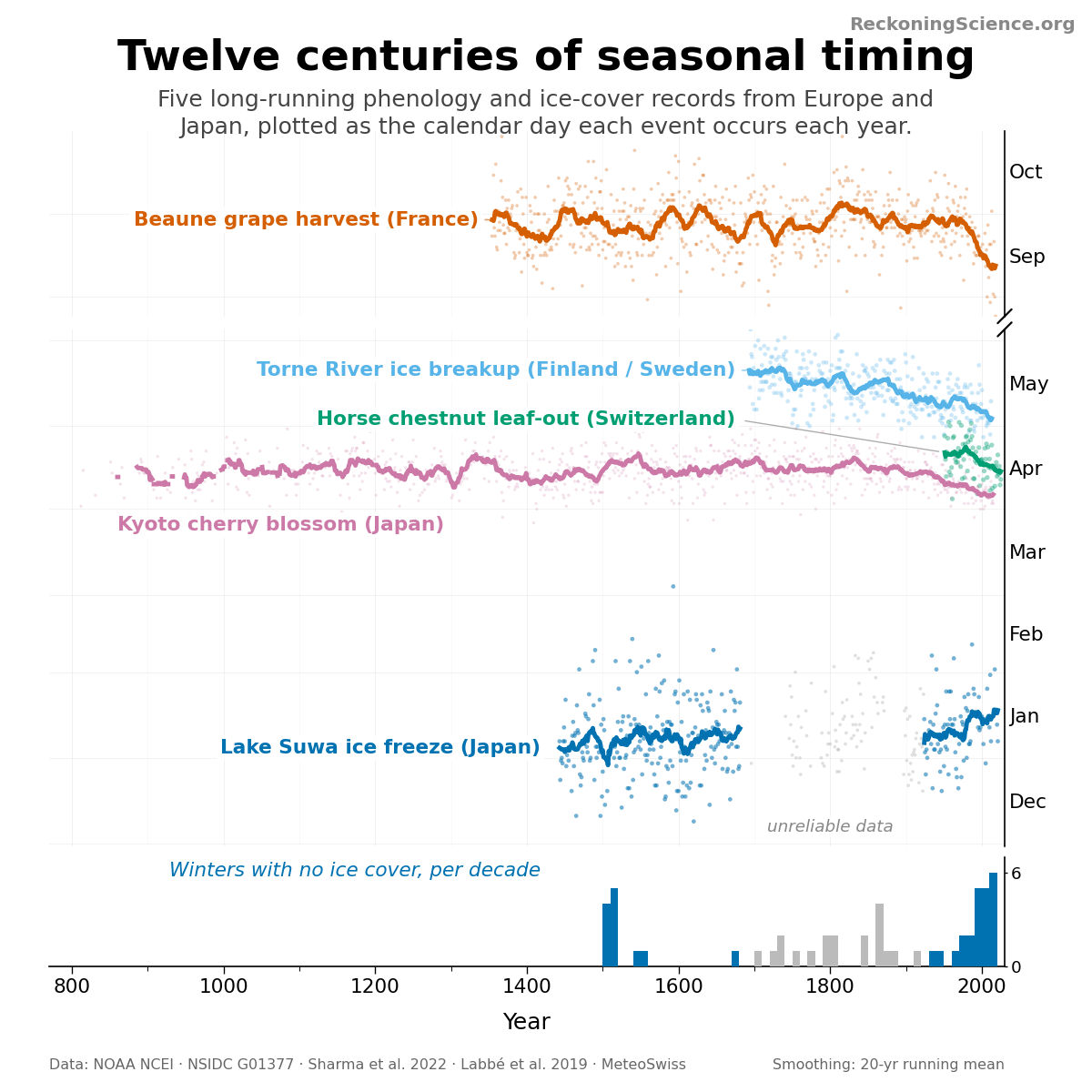
In 812, a clerk at the Heian imperial court in Kyoto wrote down the day the cherry came into full flower because the court was scheduling a blossom-viewing party (Aono & Saito, 2010). The court has long since vanished, the species in the garden has changed several times over, but someone has kept noting the bloom date for twelve centuries.
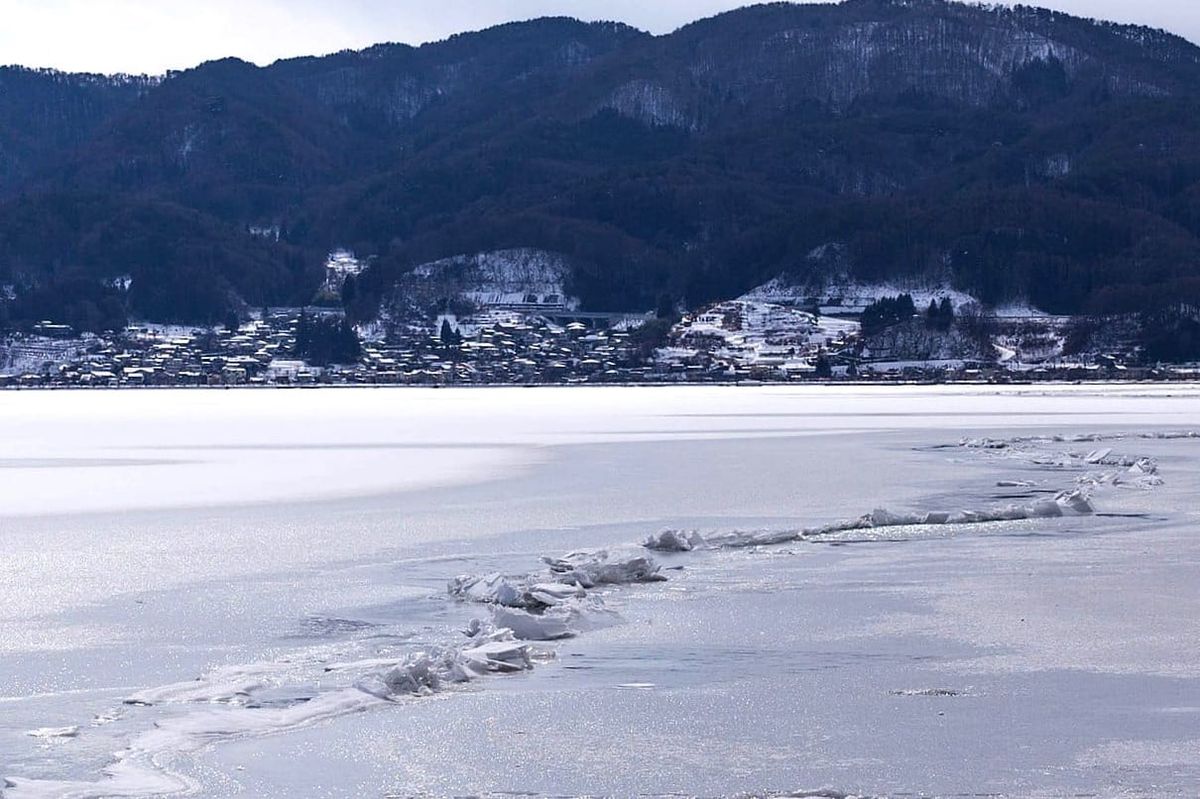
There are other records like this. In 1354, the town and abbey clerks of Beaune (Burgundy) began logging the date des vendanges, the official opening day of the wine harvest, and have not stopped since (Labbé et al., 2019). At Lake Suwa in central Japan, Shinto priests began recording the day the omiwatari pressure ridge first rose across the frozen lake in 1443; according to legend, the ridge is the path of the male god Takeminakata crossing to visit the goddess Yasakatome on the far shore. The Yatsurugi shrine formally took over the observation in 1683 and still keeps the ledger today (Sharma et al., 2016). In 1693, the Tornio merchant Olof Ahlbom began noting the day the ice broke up on the Torne River; he paused his ledger only when the Russian occupation forced him to flee in 1715, resuming when he returned home in 1721. And in Geneva, a chestnut tree on the Promenade de la Treille has been watched since 1808; the Sautier of the cantonal parliament has formally announced the date of the first leaf since 1818, and MeteoSwiss has logged horse chestnut leaf-out across more than a hundred stations since 1951.
None of these were climate observations. They were religious obligations, civic duties, agricultural calendars, and private hobbies that became a public ritual. Data collected for other purposes has, almost incidentally, given us very long time series.
The recent bend
Looking back at these records together, we start to see certain trends appearing more or less synchronously across the late 20th and early 21st centuries. Kyoto cherries bloom earlier and the Geneva chestnut leaf-out earlier across the 20th century, the Beaune harvest has shifted forward by about 13 days from 1988 onward against a 634-year baseline (Labbé et al., 2019), the Torne breaks up earlier than it once did (Norrgård & Helama, 2022), and the Lake Suwa freeze comes later, when it comes at all (Sharma et al., 2022). None of these records were collected to register climate change, but at this point in their long lives they are registering it.
A few specific years stand out. In Kyoto, peak bloom came on 26 March 2021, the earliest date in the 1,200-year series and the first time a record set on 27 March 1409 had been beaten (Christidis et al., 2022). In Geneva, it was officially recorded that spring 2003 arrived on 29 December 2002, after which 2003 itself produced no first-leaf event.
The caveats
These records are not climate measurements in the precise sense, and they confound several things at once. A cherry in central Kyoto picks up not only Japan's spring temperature but also the urban heat island that grew around it across the 20th century, and Christidis, Aono and Stott (2022) attribute roughly half of the modern 11-day mean shift in Kyoto bloom to urban warming and half to broader anthropogenic climate change. The Geneva chestnut sits inside one of the densest small cities in Europe, and a new tree was planted in 2015 after the previous one died of fungus, partially muddying the post-2018 signal. The Beaune harvest is determined by the ban des vendanges, a legal date that responds to tradition and grower decisions as well as to the grapes. The Torne breakup is observed by humans on a river basin that carried log-driving infrastructure for parts of the 19th and 20th centuries. The Suwa record has a known unreliable stretch from 1682 to 1923, and a hot-spring geyser excluded from the "complete freeze" definition since 1945.
These records, therefore, would not withstand the scientific rigor for defining climate change and would be useless in court as standalone evidence of global mean temperature change. Read together, however, they place recent climate trends in a local context that runs much longer than the instrumental record.
Climate, made local
Climate change stops being a global abstraction, a chart of temperature anomalies or a model projection or an IPCC scenario, and becomes the thing that has happened to a place. The omiwatari has not appeared for eight consecutive years, the Tornio breakup now comes earlier than it did when Ahlbom was keeping his ledger, and Japan's cherry bloom shows up systematically earlier than in the past.
What is new is that this shift now falls inside a single human life. A local climate that held steady across a thousand years can shift within one lifetime, and a grandparent and a grandchild in the same place can now know different winters and follow different seasonal calendars.
References
Aono, Y., & Kazui, K. (2008). Phenological data series of cherry tree flowering in Kyoto, Japan, and its application to reconstruction of springtime temperatures since the 9th century. International Journal of Climatology, 28(7), 905–914. https://doi.org/10.1002/joc.1594
Aono, Y., & Saito, S. (2010). Clarifying springtime temperature reconstructions of the medieval period by gap-filling the cherry blossom phenological data series at Kyoto, Japan. International Journal of Biometeorology, 54(2), 211–219. https://doi.org/10.1007/s00484-009-0272-x
Christidis, N., Aono, Y., & Stott, P. A. (2022). Human influence increases the likelihood of extremely early cherry tree flowering in Kyoto. Environmental Research Letters, 17(5), Article 054051. https://doi.org/10.1088/1748-9326/ac6bb4
Defila, C., & Clot, B. (2001). Phytophenological trends in Switzerland. International Journal of Biometeorology, 45(4), 203–207. https://doi.org/10.1007/s004840100101
Labbé, T., Pfister, C., Brönnimann, S., Rousseau, D., Franke, J., & Bois, B. (2019). The longest homogeneous series of grape harvest dates, Beaune 1354–2018, and its significance for the understanding of past and present climate. Climate of the Past, 15(4), 1485–1501. https://doi.org/10.5194/cp-15-1485-2019
Norrgård, S., & Helama, S. (2022). Tricentennial trends in spring ice break-ups on three rivers in northern Europe. The Cryosphere, 16(7), 2881–2898. https://doi.org/10.5194/tc-16-2881-2022
Sharma, S., Magnuson, J. J., Batt, R. D., Winslow, L. A., Korhonen, J., & Aono, Y. (2016). Direct observations of ice seasonality reveal changes in climate over the past 320–570 years. Scientific Reports, 6, Article 25061. https://doi.org/10.1038/srep25061
Sharma, S., Richardson, D. C., Woolway, R. I., Imrit, M. A., Bouffard, D., Magee, M. R., Bartosiewicz, M., Brookes, J. D., Efremova, T. V., Filazzola, A., Granin, N., Gulati, R. D., Hampton, S. E., Hetzenauer, H., Hörnberg, J., Hyvärinen, R., Kainz, M. J., Karpowicz, M., Knoll, L. B., … Weyhenmeyer, G. A. (2022). Loss of ice cover, shifting phenology, and more extreme events in Northern Hemisphere lakes. Scientific Data, 9, Article 318. https://doi.org/10.1038/s41597-022-01391-6