“Everybody's business is nobody's business, and nobody's business is my business”
The editor told us that we were the first ones to ask for retraction.


In summer 2025, we emailed the editor-in-chief of a toxicology journal requesting a paper retraction. This influential paper argued for the safety of a widely used herbicide glyphosate. For eight years, this paper was publicly known to be a product of scientific fraud, yet it continued circulating as independent research.
The editor told us that we were the first ones to ask.
In 2017, a trove of internal Monsanto documents was produced through litigation discovery, known as the Monsanto Papers. Billions of dollars were awarded in jury verdicts. Among other things, the documents showed that a number of papers on glyphosate were not merely sponsored by Monsanto but effectively written and researched by the company's employees, then handed to hired academics who edited them and attached their names. The documents explicitly frame this strategy as an attempt to make the work appear independent.
This fraudulent practice is called ghostwriting: the intentional misrepresentation of who is responsible for a study, designed to obscure conflicts of interest. In 2017, news outlets across the political spectrum — Fox News, NPR, and CNN — used the same or comparable language to describe the revelations. Robert F. Kennedy Jr., now the leader of the MAHA movement and then an environmental lawyer who participated in the litigation, called it "ghostwriting science" and "buying science."
Yet despite this wide coverage, retractions were never requested. Not by the lawyers and expert witnesses involved in the cases. Not by the journalists who covered the stories. Not by scientists in the field. And not by the regulators who had relied on the papers. Each profession encountered the evidence, processed it according to its own norms, and moved on.
The paper we consider here is Williams, Kroes, and Munro (2000). It is the earliest known Monsanto-placed study in the glyphosate record that internally was described as "'the' reference" on glyphosate safety.
A few months after our email, the paper was retracted. In the retraction notice the current journal's editor-in-chief, Martin van den Berg of Utrecht University described the Williams et al. (2000) paper as "a hallmark paper in the discourse surrounding the carcinogenicity of glyphosate and Roundup."
The official reasons for retraction include undisclosed Monsanto authorship, reliance on the company's unpublished data, failure to disclose financial compensation. No new information or data was used in this decision that had not been publicly available since 2017.
The case had been complete for years. No one had acted on it.
How did this happen?
There is no single explanation for why a fraudulent paper survived in the scientific literature for so long, but we can mention several factors that likely contributed to what amounted to collective blindness.
A compromised journal
Regulatory Toxicology and Pharmacology, the journal where the study in question was published, has a history of scandals. It was founded in 1981 by Fred Coulston and Albert Kolbye. Coulston is known for having run the largest captive chimpanzee colony in the world (650 animals at its peak) until the Coulston Foundation lost its government contracts due to extensive animal welfare violations. (It declared bankruptcy in 2002.)
In 2002, 45 scientists wrote an open letter accusing the journal of (barely) concealed pro-industry bias, a lack of independent peer review, and failure to disclose conflicts of interest. The letter's coordinator, Virginia Sharpe of the Center for Science in the Public Interest, commented that the journal "reads like an industry trade publication, but it's masked as a peer-reviewed journal." But despite the complaint, the pro-industry bias continued. A systematic study covering 2013–2015 found that 96% of the journal's tobacco-related papers had authors with tobacco industry ties, and 76% of those papers drew conclusions favorable to industry; none drew negative conclusions.
Until 2003, the journal's editor was Gio Batta Gori, who ran it while receiving payments from the tobacco industry. In 1991, the Tobacco Institute paid Gori $30,000 to write an article dismissing the risks of secondhand smoke, which he then published in his own journal. In the landmark 2006 RICO case United States v. Philip Morris, Judge Gladys Kessler explicitly mentions Gori's industry role.
Williams, Kroes, and Munro (2000) was published during Gio Batta Gori’s tenure. Martin van den Berg was not appointed co-editor-in-chief until 2019. His retraction notice states that he "lost confidence in the results and conclusions of this article" and believes "the retraction of this article is necessary to preserve the scientific integrity of the journal."
It is unclear what standards of integrity apply to a journal with this track record. It is still actively operating and is generally treated as a legitimate venue; papers published in it are integrated in the regulatory citation ecosystem. For many scientists working in this field, the journal's history evidently does not prevent them from publishing in it.
"Let nothing go"
Monsanto did not simply ghostwrite papers and hope for the best. The company ran a systematic campaign to control the information environment around its products.
"Let nothing go" was a key prong of the company's "Freedom to Operate" strategy, implemented through the consulting firm FleishmanHillard under a €14.5 million contract The operation spanned the EU and the United States, with the aim of leaving nothing about Monsanto, its products, or GMOs undefended. It mapped 1,475 individual stakeholders across several European countries, and its scope extended down to the level of individual social media comments. A Monsanto executive acknowledged in a July 2015 email that "much of" the newly favorable media content had been "actively placed by FleishmanHillard." Perhaps not coincidentally, FleishmanHillard had previously also represented The Tobacco Institute.
The ground was prepared
The 2000 ghostwritten paper did not appear in a vacuum. The science around glyphosate had been shaped by industry pressure from the very beginning.
Initial EPA assessments in 1984 concluded that glyphosate was possibly carcinogenic. One study that EPA reviewed, in mice, reported that "the mouse oncogenicity study indicates that glyphosate is oncogenic, producing renal tubule adenomas, a rare [kidney] tumor, in a dose-related manner." That study was one of Monsanto's own. In March 1985, eight members of the EPA's Toxicology Branch signed a consensus review classifying glyphosate as a Category C oncogen — "possibly carcinogenic to humans."
Industry took care of it promptly. Monsanto arranged for Dr. Marvin Kuschner, a pathologist and founding dean of the medical school at SUNY Stony Brook, to re-review the mouse kidney slides. An April 1985 internal memo from George Levinskas, Monsanto's manager for environmental assessment and toxicology, implied that a favorable outcome was assured — before Kuschner had even examined the slides. Kuschner then identified a small kidney tumor in the control group of mice, one that no one had noted in the original study report. The finding was significant: if an unexposed mouse also had a tumor, the tumors in the glyphosate-exposed mice could be dismissed as unrelated to the chemical. Subsequent evaluation by other pathologists found no evidence of a tumor in the control mouse. Yet, as late as 2016, the EPA was still citing the phantom control-group tumor in its assessments.
By 1991, an EPA review committee had reclassified glyphosate as Group E — "evidence of non-carcinogenicity for humans" — over the objections of at least two committee members who refused to sign the report. When the EPA asked Monsanto to conduct a repeat mouse study to resolve the uncertainty, the company refused.
By the time the ghostwritten papers arrived, they were reinforcing a narrative that had already been established.
Why does it matter?
One might ask whether the retraction of a single twenty-five-year-old paper is worth the effort. Pro-glyphosate outlets have framed it as "a procedural disclaimer issue" that "does NOT alter the overwhelming scientific consensus." The quick answer is to read the retraction notice itself: undisclosed corporate authorship, reliance solely on Monsanto's unpublished data, omission of available studies, and possible undisclosed financial compensation. These are not procedural footnotes.
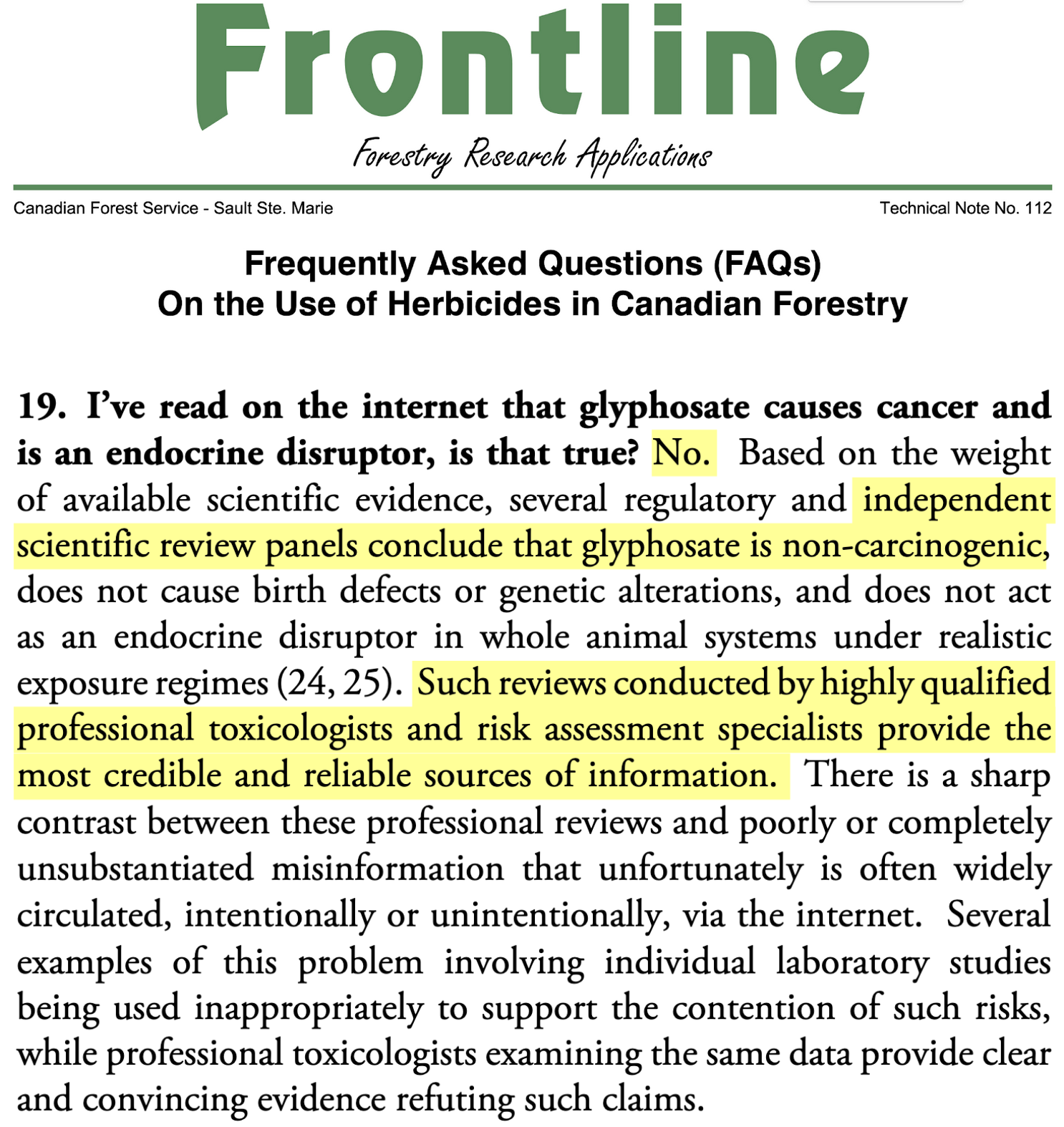
More important, though, was the evidence of ongoing impact. To assess the impact, we — Sasha Kaurov and Naomi Oreskes — published a study tracing the paper's influence through three domains. What we found showed that the impact was ongoing.
- Academic literature. Williams et al. had accumulated over 1,300 citations on Google Scholar, placing it in the top 0.1% of all publications mentioning glyphosate — with no drop-off after 2017, when the ghostwriting was revealed. Of approximately 500 papers for which we obtained full text, only a handful cited it with any caveat about its origins.
- Policy documents. Twenty-nine of 36 regulatory documents we identified — from the U.S. EPA, WHO, IPBES, Health New Zealand, and others — cited it at face value, with no acknowledgment of the ghostwriting evidence. Some of these citations postdate 2017.
- Wikipedia. Editors who attempted to contextualize the reference after the Monsanto Papers became public had their edits reverted, on the grounds that court documents did not count as peer-reviewed critique. Moreover, Wikipedia feeds AI training data. The pipeline from corporate ghostwriting to large language models is now direct.
An un-retracted ghostwritten paper is, for all institutional purposes, a trustworthy paper.
Why should a false paper be retracted?
The case for retraction was straightforward. All Elsevier journals follow COPE (Committee on Publication Ethics) guidelines, which state that retraction is warranted when there is clear evidence of "any form of misrepresentation (e.g., fictitious authorship) that compromise the reliability of the findings." COPE further specifies that journals should address integrity concerns regardless of article age. The evidence had been publicly available for eight years. The standard had been met for eight years. The retraction required nothing more than someone pointing this out.
What now?
Williams, Kroes, and Munro (2000) was one paper. The Monsanto Papers revealed a series of ghostwritten review articles stretching across two decades and multiple journals. And the revealed internal documents most likely do not represent the full inventory.
Of the papers that are known, Williams et al. is the first to be retracted. The Center for Biological Diversity previously requested retractions for several ghostwritten glyphosate papers published in Critical Reviews in Toxicology. That effort produced only an expression of concern — a weaker editorial action that flags problems without withdrawing the paper.
Two more papers from the list are now requested for retraction.
First is Kier and Kirkland (2013), internally framed as a successor to the 2000 paper and produced using what Monsanto executive William Heydens described as the same approach. The authors intentionally excluded a Monsanto employee, David Saltmiras, who wanted to be a co-author (and who one of the listed authors believed deserving) yet was excluded specifically to make the paper appear not to be influenced by Monsanto.
Second is Greim et al. (2015). A paper that the same Monsanto employee Saltmiras listed in a 2015 performance evaluation as an accomplishment: "ghost wrote cancer review paper Greim et al. (2015)." Jason MacLean, an expert witness and graduate student at the University of Chicago Law School, has traced how that paper goes beyond ghostwriting into outright fabrication. To dismiss a key mouse study showing significant carcinogenicity (Kumar, 2001), Greim et al. (2015) manufactured an unsupported claim that the results were compromised by viral infection. Regulators — including the ECHA and the German BfR — and toxicologists — including Toxicologist Dr. Peter Clausing and Dr. Christopher Portier — found no evidence supporting the claim. Yet the fabrication was spread by EPA as an established fact and then adopted by EFSA and other pesticide regulators as well as courts, including the Australian Federal Court in McNickle v Huntsman [2024] FCA 807.
These papers were published in Critical Reviews in Toxicology, not in Regulatory Toxicology and Pharmacology. The editor there has not been responsive, and the journal's ethics office has not provided meaningful replies. The one retraction we have achieved happened because we found an editor who was willing to act. The structural question — what happens when the editor is not willing — remains open.
Sign up to ReckoningScience.org to receive updates.
Nobody's job
Why did nobody press for retraction earlier?
Perhaps it is a manifestation of the bystander effect — the phenomenon, formalized by John Darley and Bibb Latané in 1968, in which people fail to act because they assume someone else is responsible, because they fear overstepping their role, or because the inaction of others signals that nothing is wrong. Or perhaps it is what political theorist Dennis Thompson called the problem of many hands. Everyone could see the problem, but nobody thought it was theirs to fix.
Whatever the diagnosis, the case exposes something systemic. It reveals the vulnerabilities of scientific publishing to corporate influence.
The title of this piece — "Everybody's business is nobody's business, and nobody's business is my business" — borrows from Clara Barton, founder of the American Red Cross. She saw its mission as arriving where others assumed someone else would show up. Much like the case of a fraudulent paper that no one asked to retract. (The first half of the proverb goes back to Daniel Defoe in 1725, in a very different context.)
But looked at differently, this is also a story about untapped opportunity. There may be other low-effort, high-impact interventions sitting in plain sight, invisible only because they fall between professional domains. Those can be addressed with no major investment of resources. This, however, is a short term remedy. In the long run, though, the scientific community needs a plan to address the problem broadly, and in a timely fashion.