How Australia and NZ weighed the paraquat and Parkinson's evidence


On 24 July 2026, Syngenta announced it was withdrawing every paraquat product it sells in Australia and New Zealand. The reason given by the company's managing director for the region was not safety: “Regulatory constraints, combined with a highly complex and increasingly expensive supply chain, have made the paraquat herbicide products commercially unviable.” Paraquat itself will not necessarily disappear; growers note the generics will likely keep coming.
In July 2025, weeks before trial in the US, Syngenta settled the claim of Douglas Nemeth, a farmworker with Parkinson's; in August it signed a wider agreement covering much of the US litigation, in which more than 6,000 people with Parkinson’s have sued. Terms were not disclosed and nothing was admitted. The company maintains the evidence linking paraquat to the disease is “fragmentary” and “inconclusive.” However, that litigation produced, through discovery, the company's internal record of how it ran and reported its own safety studies.
This piece is about what those studies showed, and how they were used. As we wrote previously, bad science produced in a larger country can travel to regulation of smaller countries.
The scientific basis for Australian approval of paraquat
In June 2026, a month before Syngenta withdrew its paraquat products, Australia’s pesticide regulator finished a review it began in 1997. The Australian Pesticides and Veterinary Medicines Authority (APVMA) decided not to ban paraquat, a widely used weedkiller. It cut the maximum application rate from 1,150 to 231 grams per hectare. Around 70 countries have banned the chemical.
The APVMA found that the “weight of evidence” does not show that approved use of paraquat increases the risk of Parkinson’s disease.
How the regulator weighed that evidence is an interesting case study.
Paraquat has been studied for decades as a possible cause of Parkinson’s disease. Its structure resembles MPTP, a toxin known to cause Parkinson’s-like symptoms in people. The disease involves the death of dopamine-producing neurons in a part of the brain called the substantia nigra. Many studies have injected paraquat into mice and reported that these neurons die.
A 2002 study by Alison McCormack, Mona Thiruchelvam and colleagues was the first to count these neurons using stereology. Other labs reproduced the result.
In a 2016 toxicology report, the APVMA’s Office of Chemical Safety set that study aside. The reason had nothing to do with its methods or findings. It was this:
Due to the uncertainty surrounding the integrity of the data subsequent to this author’s fraudulent action, these studies have been deemed unsuitable for regulatory use by the OCS [the Office of Chemical Safety].
The misconduct was real. In 2012, the US Office of Research Integrity found that a co-author, Thiruchelvam, had fabricated cell-count data. But the problem was in two of her own 2005 papers, which were retracted. It was not in the 2002 study, and she did not perform its counts.
The regulator ruled out McCormack’s study and eight more across the wider review, because of what it called a “critical issue” — Thiruchelvam’s co-authorship. The footnote states: “not suitable for regulatory use following fraudulent actions by co-author on another paper.”
This is guilt by association. Other studies reporting the same effect, but not co-authored by Thiruchelvam, stayed in the report: Brooks and colleagues (1999), who used the same injection method and found up to 94% neuron loss, along with studies by Ossowska, Shimizu and others.
A 2024 APVMA report later summarised the position this way:
…more recent, well-conducted studies failed to reproduce these findings in mice by either oral or intraperitoneal administration. No effects were found on the substantia nigra (SN)… some of the original studies reporting a positive association have since been withdrawn due to fraudulent reporting of results.
The “more recent” work the regulator relied on was Beck (2012, 2013). Melissa Beck was a scientist who conducted studies for Syngenta, paraquat’s manufacturer. They were reported in the academic literature as three papers — Breckenridge et al. (2013), Minnema et al. (2014) and Smeyne et al. (2016) — with largely the same authors. None of them found a significant effect of paraquat on neuron loss.
The regulator explicitly favoured these studies because of their openness:
Unlike other studies showing a possible neurotoxic effect following ip [intraperitoneal — into the abdominal cavity] injection, the experimental methodology and raw data from the Beck study was available to the OCS [Office of Chemical Safety] which increases its value from a regulatory perspective. The comprehensive methodology utilised in the Beck (2012a,c) study leads OCS to conclude that the reproducibility and/or reliability of findings in other studies showing effects in the brain following injection of paraquat are questionable for regulatory purposes.
As we see below, that openness is questionable.
Internal records
That US litigation, mentioned at the beginning, made public internal records showing how those studies came to be. Among other things, they show that before those negative studies were published, a Syngenta scientist, Louise Marks, ran the same experiment and did find the neuron loss.
In fact, Marks's experiments followed the setup, with the same strain and by the same route, used in the Parkinson's Institute's studies by McCormack et al. (those were excluded by the APVMA). Marks's experiments got 21–24% against the Parkinson's Institute's 25–30%. An internal summary recorded that the effect “has been replicated in Syngenta studies”.
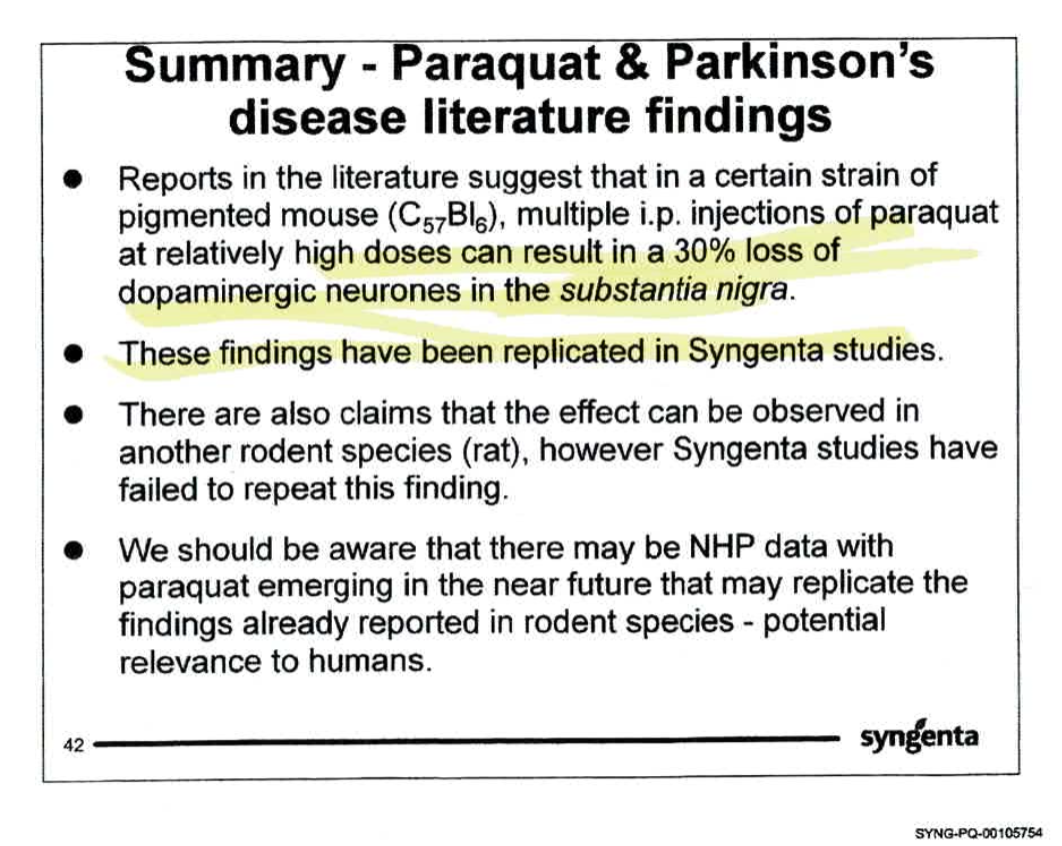
Those positive internal studies were never published.
The authors of the no-effect papers knew of this earlier positive result. Two of them, Nicholas Sturgess and Lewis Smith, were Marks’s own supervisors. Under oath, the company’s witness conceded that the company had never found a flaw in Marks’s work and provided an excuse for why the replications were not published:
to get published … simple replication of results which are also in the public domain is not necessarily that easy. Journals will not always accept studies which simply say what is already known.
Marks’s result did not simply repeat what was known — it contradicted the company’s public papers. It reached US regulators only in 2019:
The company only told the EPA about the Marks' data after lawyer Steve Tillery, who in 2019 was suing Syngenta on behalf of people with Parkinson's, threatened to send the evidence to the EPA himself.
On this record, we asked four journals to investigate and, if warranted, retract four Syngenta-linked papers. Three are the mouse studies in NeuroToxicology, Regulatory Toxicology and Pharmacology, and PLOS ONE (we sent requests on June 26, 2026). The fourth is a 2010 review in Cell Death & Differentiation that the company edited without disclosing its role. Of the four journals, only two have acknowledged the request: PLOS ONE on July 7, and Regulatory Toxicology and Pharmacology on July 15.
If any of them proceeds with a retraction, should every study by those authors be struck from the regulatory record? Applied consistently, the principle would take roughly 15 “no effect” reports from the same Syngenta team. In that hypothetical, the harm studies would remain (the independent ones, by Brooks, Ossowska and others), but the “no effect” side would have no such base: its pivotal studies are all Syngenta’s own.
It is, admittedly, a harsh rule — to discredit everything a person co-authored over a single integrity failure. Is it a reasonable policy?
Actually, there is evidence that the pattern repeats. A co-author of that Cell Death & Differentiation review, the pathologist Colin Berry, later joined a 2016 glyphosate “expert panel” in Critical Reviews in Toxicology which argued that the weedkiller non-carcinogenic. The journal flagged the panel's papers with an expression of concern in 2018 for undisclosed involvement by the manufacturer, Monsanto.
New Zealand's part of the story
In December 2019, New Zealand’s Environmental Protection Authority closed its own paraquat reassessment. Answering a submitter, it said directly:
The APVMA found no causal relationship between paraquat and Parkinson's disease. This is the position adopted in this assessment.
New Zealand’s 2019 assessment also set inhalation aside as a route of exposure on the grounds that paraquat barely evaporates — “not relevant, due to low vapour pressure,” the science memo recorded. The number came from Syngenta, whose submission told the regulator that the vapour pressure was so low that “exposure to vapours can be excluded.” In January 2024, the company gave the US EPA its own new study. The measured value was roughly four thousand times higher. Last November, the US EPA said there was now “greater uncertainty” about how far paraquat volatilises, and asked manufacturers for data.
New Zealand kept paraquat at a maximum rate of 600 grams per hectare, more than twice what Australia now permits. Despite all these changes in regulation worldwide, the NZ EPA has no plans to reassess paraquat, according to its reassessment work plan, updated this July.
What is next?
We have looked at this before. In The afterlife of a ghost-written paper, we followed a review that had been shown in court to be industry-written, and found it still cited — by regulators and by academics — still doing its work. Exposure in a courtroom does not reach into a journal, and the scientific record does not correct itself.
That leaves two kinds of work, and they belong to different people.
The first is cleaning the record: retraction requests, corrections, expressions of concern. It is tedious work that more people should be doing. And the hope is that regulators will have a cleaner pool of literature to work with.
The second belongs to the regulators themselves. New Zealand, Australia and most other countries currently cannot (but maybe should) generate their own experimental record on chemicals like paraquat. What they can do is be more careful and open about what evidence they adopt. That means treating research integrity as a field worth investing in and writing national policy around — not as something that arrives from elsewhere prepackaged.
You can support our work by signing up or with a one-time donation: